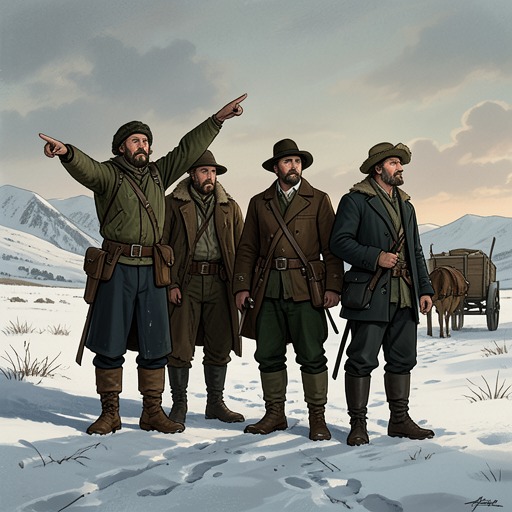
Bison herds charge for an escape and hunters drive them back
Butcher's CrossingWhen the surviving bison try to leave the valley, Miller turns their attempted escape into a coordinated hunt. He sends Will Andrews and Fred Schneider to opposite sides of the valley and holds the center, directing them to fire at any herd that approaches. Across six charges, the three hunters drive the animals back. The episode makes the bison’s immense, unified movement visible even as it shows how the hunters use that force to keep the slaughter going.
Causes and Background
The escape attempt comes after sustained killing has reduced the herd. In Kansas, Miller recalls, spring once brought plains black with bison, and a two-week hunt could yield a thousand or fifteen hundred animals. By the time he speaks, hunters are more fortunate to take two or three hundred in a trip; he expects Kansas to be exhausted within a year or two. The valley hunt extends this depletion on a more concentrated scale. Miller’s determination to keep hunting, rather than leave the animals alive, has become the practical condition shaping the expedition’s work.
The labor has grown relentless. Schneider and Andrews skin and butcher the animals Miller leaves scattered across the valley, working late and rising before dawn to cut into stiff carcasses. As they labor, Miller’s rifle continues to sound, repetitive and unyielding. The surviving animals wander among their dead companions over ground marked by dried blood. Andrews recognizes that he has never seriously imagined the herd’s complete extermination, although he has come to understand that Miller will not leave while a single bison remains. The attempted breakout therefore tests whether the animals can escape a hunt organized around their total destruction.
The damage also belongs to a wider history of commercial hunting. Miller remembers a landscape of bones stretching for miles, from Pawnee Fork toward the end of Smoky Hill, the residue of Kansas’s great hunts. Later, J.D. McDonald notes that hunters are selling bison meat to the railroad while leaving hides to rot where the animals were skinned. Together these details place the valley’s killing within a system that rapidly consumes the animals and shifts its use of them according to market opportunity.
The Herds Break for the Slopes
The hunters are gathered among the skinned carcasses when Miller rides toward them at speed. He pulls up so abruptly that his horse rears. Almost panting, he tells the men that the bison have divided into ten or twelve herds and are trying to get out of the valley; he cannot turn them back quickly enough alone and needs help.
Schneider objects to intervening. In his view, only a couple of hundred animals remain, and letting them go is preferable. Miller does not engage that proposal. He assigns Andrews a position west of the mountain’s flank, two or three hundred yards away, orders Schneider east, and places himself between them. If a herd comes toward one of them, each hunter is to fire a few times to make it change course. Miller expects the herds to arrive two or three at a time, not all together. His plan depends on using gunfire as a barrier rather than on killing each animal in a direct pursuit.
Andrews rides to his position and waits. The first warning is a rumble that shakes the ground and makes his horse recoil. He initially looks toward the southern mountains as if he has heard thunder, but a cloud of dust appears in the distance. The bison then emerge from shadow into sunlight, running at extraordinary speed. A group of thirty or forty does not move in a neat line: its members swerve and shift, yet remain together, as though the herd were one animal with a shared direction. The apparent unity makes the oncoming mass seem almost impossible to redirect with a rifle.
The Hunters Turn the Charges
Andrews hesitates as the herd closes, doubting that the small rifle in his arm can influence its course. Miller remains mounted and watches him. Andrews urges his horse forward despite its reluctance, then fires at the approaching animals from less than three hundred yards. One bison falls; the others stream around it without breaking their advance. Andrews fires again. When the herd veers left across the valley toward Miller, he rides alongside it and shoots into the group. Gradually, the animals turn and run back toward the direction from which they came.
The maneuver is repeated at the other side of the valley. Andrews hears another rumble and sees a somewhat smaller herd charge toward Schneider. Schneider fires into it and rides after the animals as they turn, forcing them back as well. The scene alternates between each hunter’s position and the valley-wide movement of the animals: the threatened escape arrives as separate, successive charges, while Miller’s formation lets the hunters respond to one herd at a time.
Between the three men, six charges are repelled. Miller waits several minutes after the last rumble fades, then signals the others to follow him toward the center of the valley. Even as they ride, they listen for another approaching herd. Miller scans the ground in the direction the animals fled, maintaining his attention on whether the attempt might resume.
Consequences and Significance
Miller declares the operation successful and expects the bison will not try to escape again. The immediate result is not a departure from the valley but the hunters’ renewed control over the remaining herd. Schneider’s alternative—allowing the animals to go—has been overridden by Miller’s decision to hold them there, and Andrews has taken part in turning the animals back.
For Andrews, the encounter changes the way he sees the bison. He has already killed some, skinned hundreds, eaten their meat, and lived amid their smell and blood, but the charging herd makes him confront them as a collective presence rather than merely as carcasses and work. Their coordination appears purposeful to him. Miller rejects the idea that their behavior can be reliably understood: after twenty years of hunting, he has seen them charge up a bluff and pile into a deep canyon, scatter at the sight of a crow, or remain unmoved as people walk among them. His rule is to attack and kill while possible, not to assume that he can predict them.
That contrast gives the episode its force. The herd’s unified motion briefly presents a power the hunters cannot simply master by understanding it; they can only meet it with positioned riders and repeated rifle fire. Yet their success turns the animals’ failed escape into a continuation of the same destruction that has already left the valley strewn with bodies. The spectacle of collective life and the hunters’ practical refusal to let it survive occupy the same scene.